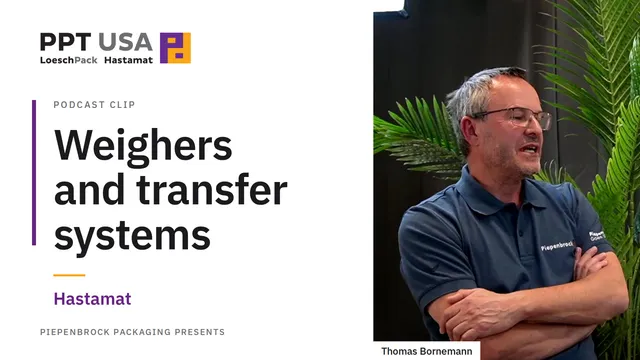
Captions on · Transcript below · Watch on YouTube (2:49)
How a Flow Wrapping Line Works
Christoph Recher, Sales Manager at LoeschPack, describes a typical line: products from a cooling tunnel enter a feeding and distribution system with buffering, then a flow wrapper that forms film into a tube and seals it longitudinally, then crosswise, before cartoning or a vertical bagger. Thomas Czioska, Head of Sales & Marketing, explains primary packaging, shelf-ready cartons, palletizing and case packing.
Key takeaways
- Christoph Recher explains that LoeschPack's feeding and distribution system takes over products from the production line and can buffer them to accommodate machine downtime.
- In the flow wrapper, film from a reel is formed into a tube, products enter through the in-feed chain, and the pack is sealed first longitudinally, then crosswise.
- Thomas Czioska says primary packaging, where the naked product is handled, is the most critical for hygiene, while secondary packaging is typically a shelf-ready carton.
Common questions
- How does a flow wrapper work?
- According to Christoph Recher of LoeschPack, products in the in-feed section are individualized and fed into an in-feed chain. Film coming from a reel is formed into a tube, the products are fed into that tube, and the pack is sealed first longitudinally, then crosswise. A 3D check can verify each product before it enters the machine.
- What is the difference between primary and secondary packaging for chocolate bars?
- Thomas Czioska of LoeschPack explains that primary packaging, typically a flow wrap for a chocolate bar, handles the naked product and is the most critical for hygiene. Secondary packaging puts the wrapped products into a carton or multi-pack, typically a shelf-ready carton. Some customers then go directly to a palletizer; others add case packing for shipping.
- What equipment comes after a flow wrapper?
- Christoph Recher of LoeschPack says that after the flow wrapper, products can go into a vertical bagger, such as one from Hastamat, or into a shelf box in LoeschPack's own cartoning system. When Tom Rougeux summed it up as handling everything from the end of the customer's production line to shelf-ready packaging, Recher answered, "Absolutely."
Transcript
Christoph Recher, Sales Manager, LoeschPack
The products usually come from a production line, which is most of the time a cooling tunnel or something similar. From there we take over the products with our feeding and distribution system, where we also have various capabilities of buffering the products to accommodate machine downtime. Right after that, the products are fed to our flow wrapper.
The flow wrapper basically works in a way that the products in the in-feed section are individualized and fed into an in-feed chain. Before that, we have the possibility to do a 3D check of each single product, even at very high speeds, to make sure that there is no product out of specification that will be fed into the machine. The machine itself works in a way that the film coming from a reel is formed into a tube, and in that tube the products are fed in through the in-feed chain.
After that, the products are sealed first longitudinally, then crosswise. After our flow wrapping machine, we could either put the products into a vertical bagger, like one from Hastamat, or we put the products into a shelf box in our cartoning system, which we also supply.
Tom Rougeux, President, Piepenbrock Packaging
It sounds like you handle everything from the end of the customer's production line to shelf-ready packaging.
Christoph Recher
Absolutely.
Tom Rougeux
Very well.
You mentioned different kinds of packaging for products. Could you walk our guests through the different kinds of packaging that they need to be familiar with, the terms and what those terms mean?
Thomas Czioska, Head of Sales & Marketing, LoeschPack
The primary packaging, when we're talking about a chocolate bar, is typically a flow wrapper, where you really have the naked product to handle. That's, I would say, the most critical one in terms of hygienic questions. After the primary packaging, when you have packed the single product, you went through and bring it normally in a carton or in a multi-pack.
More easy, of course, because you don't touch the naked product anymore. Put it normally in a carton. Typically, it's a shelf-ready carton at that point.
In the store, you only pull up the lid and put it in the store. Some of the customers go directly after the secondary packaging to a palletizer. Some of them depend on the distribution afterwards using a case packing.
They put the shelf cartons in an additional carton only to ship it.
Tom Rougeux
Got it.