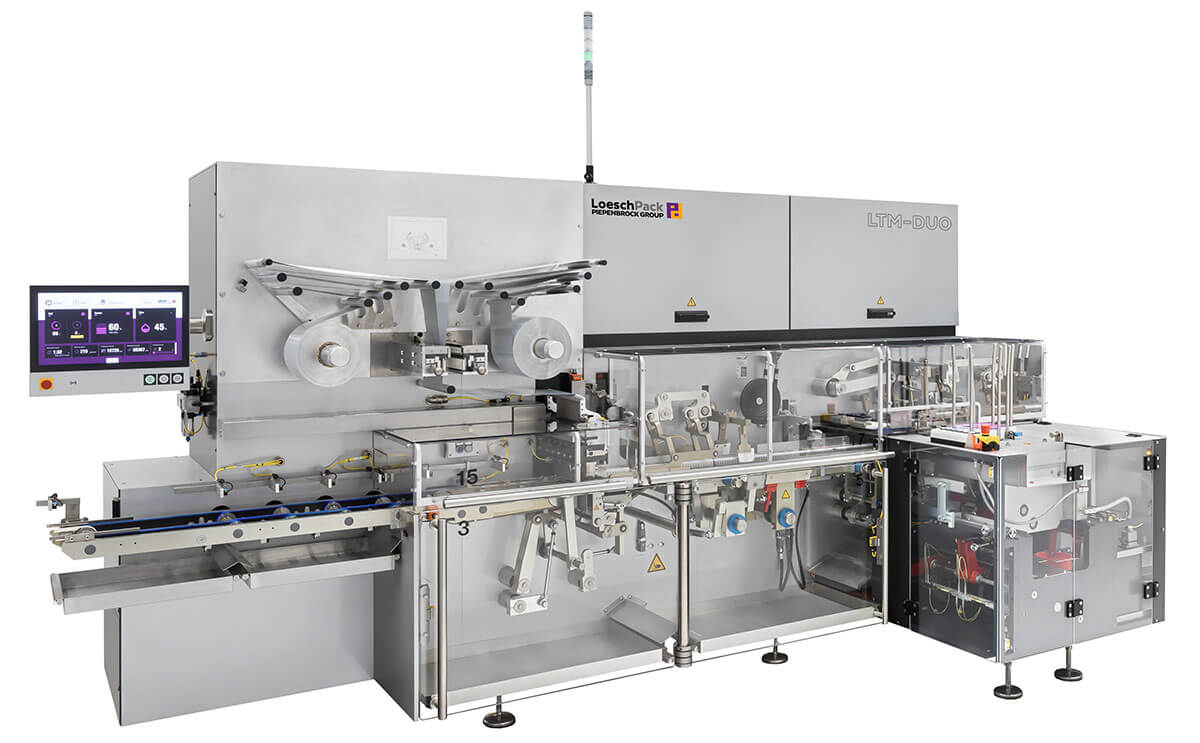
Cookie, Biscuit and Wafer Packaging Machines: Handling Fragile Product
A cookie survives the oven and breaks on the conveyor. Stack and wrap or weigh and bag is the first decision, and the handling ahead of the packaging machine is where yield is won.

A cookie survives the oven and breaks on the conveyor.
That is the whole problem in one sentence. Baked product leaves the process intact and fails somewhere in the hundred feet between the cooling tunnel and the case, usually at a transfer nobody has looked at in years. By the time it reaches the packaging machine the damage is already done, and the packaging machine gets the blame.
So this page starts with the format decision, then spends most of its time on the part of the line that is not the packaging machine.
Stack and wrap, or weigh and bag?
Cookies sit right on the line between the two architectures, which is why they turn up in both catalogs.
Stack and wrap
Cookies are collated into a slug or a stack and flow wrapped horizontally. The pack is rigid, the product is supported by the pieces around it, the piece count is known and the pack presents well on shelf. This is the classic biscuit format and it protects fragile product better than anything else.
The engineering sits in the collation: something has to build a neat, correctly counted stack at rate. LoeschPack builds the feeding, distribution and collation equipment alongside the wrapper, so that stage is designed as part of the same system.
Weigh and bag
Cookies are weighed to a target and dropped into a bag formed around them. This suits share bags, mixed assortments, bite-size products and anything sold by weight instead of by count. It is faster to change format and far simpler upstream, since nothing has to be oriented or counted.
The engineering sits in the drop, and Hastamat built the VMW machine for exactly that: a compact multi-lane cookie machine running at up to 500 products per minute on a single lane and up to 12,000 products per minute across up to 12 lanes, handling round, rectangular, stamped, filled and double cookies stacked or upright.
Choosing between them
- Does the customer expect a specific number of cookies? A stack has a known count. A bag sold by weight does not.
- Is the product sold as a premium item or a share bag? The pack format is a commercial decision that the equipment then has to serve.
- How fragile is the product in isolation? A thin, wide, low-fat cookie asks more of the transfer design than a dense one, and both routes can be engineered for it.
- How many formats do you run? Bagging changes format quickly, and a collation and wrapping line is specified with its whole format range in mind.
VFFS versus flow wrapper is the direct comparison if you are still weighing the two architectures generally, and what packaging machine do I need works the question from the product end.
Where breakage actually starts
Almost never at the packaging machine. Walk the line backward from the bagger or wrapper and look for these:
- Drops between conveyors. Every fall is an impact, and several small ones do more cumulative damage than one designed transfer.
- Accumulation. Product backing up means product pressing against product, and the pieces at the bottom of a queue take the load for everything behind them.
- Lane changes and side transfers. Anywhere product is pushed sideways or turned, edges chip.
- Speed mismatches. A fast conveyor feeding a slow one creates a pile-up that produces both breakage and starvation downstream.
- The cooling stage. Product packed warm is softer, more prone to marking and can distort under its own stack weight.
Fixing these raises yield on every SKU at once, and it raises output too, because breakage and stoppages travel together. Packaging automation ROI covers how to value that.
What we need to specify a line
Both routes are ours to build. LoeschPack has made flow and fold wrapping, feeding, distribution and cartoning since 1919. Hastamat has made weighing, dosing and vertical bagging for over 60 years, including the multi-lane cookie machines. Both belong to the Piepenbrock Group, family owned since 1913, and Piepenbrock Packaging Technologies (PPT USA) is its North American arm. One team can therefore look at both routes and recommend the one your product deserves.
Send us the cookie: diameter, thickness, weight and how it behaves when you drop one on a bench. Tell us the pack you need, whether the count is fixed, the rate you need sustained and where you think breakage is happening today. You will get the architecture that fits, and a trial on your own product so the rate and the yield are proven before you buy.