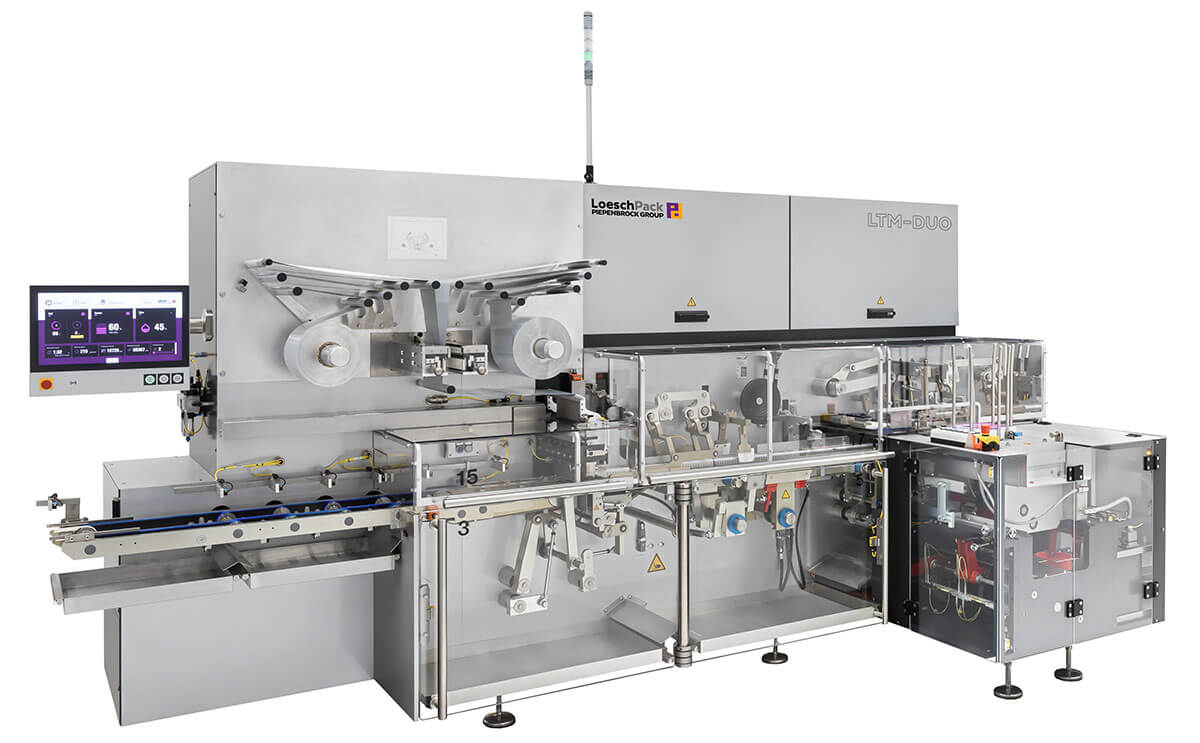
VFFS vs. Flow Wrapper: Which Packaging Machine Do I Need?
One machine wraps a piece. The other weighs out a quantity and bags it. Your product has usually made this decision already, and Piepenbrock Packaging can tell you which way it points.

Two quotes are sitting on your desk, and they do not describe the same machine doing the same job.
A flow wrapper handles one product at a time. A vertical bagger weighs out a quantity and drops it into a bag. Which one belongs in your plant is usually settled by the product itself, long before anyone opens a specification sheet.
Both architectures are ours. LoeschPack builds the horizontal side, Hastamat builds weighing and vertical bagging, and both sit alongside Piepenbrock Packaging in the Piepenbrock Group. One team can therefore specify either architecture, and the recommendation follows your product.
One handles pieces. One handles quantities.
A flow wrapper packages a piece. Product travels horizontally on a chain, spaced by flights, while film forms into a tube around it. One seal runs the length of the tube, two more close the ends, and a cut releases the finished pack. Every item is handled individually and stays oriented from infeed to discharge.
A vertical form fill seal machine packages a quantity. Film is drawn down over a forming shoulder into a standing tube, the bottom is sealed, a weighed amount falls in from above, and the top seal closes and cuts the bag free. No single piece is ever picked up or oriented. Gravity does the filling.
Every other difference between the two traces back to that one.
Where the answer is obvious
Flow wrapping
Chocolate bars. Protein and granola bars. Biscuit slugs, wafers, tablets, bar soaps and most goods sold as a single unit. If your product holds its shape and the pack is meant to show that shape off, this is your architecture.
Flow wrapper ROI covers what really determines output on these lines, and chocolate and bar packaging covers the confectionery detail.
Vertical bagging
Chips and extruded snacks. Nuts, frozen vegetables, shredded cheese, pet food, confectionery pieces, powders and granules. Anything sold by weight, where nobody would dream of orienting a single unit and the pack is a container instead of a wrapper.
The VFFS buyer's guide covers the full bagging line, and multihead weighing covers the stage that usually decides both your rate and your margin.
The case that goes both ways
Cookies. They appear in both catalogs, and for good reason.
A cookie holds its shape, stacks neatly into a slug and flow wraps into a rigid, well-protected pack. A cookie is also weighed and dropped loose into a pillow bag, sold by weight, at high speed, in plants all over North America. Both run at scale right now, so the decision comes from your format and your market, not from the equipment.
Three things can settle it:
- The pack your market expects. A stacked slug and a loose bag are different products at different price points, and that is a commercial call before it is an engineering one.
- How much breakage your product tolerates. Vertical filling includes a drop, which Hastamat engineers around for delicate product. Horizontal wrapping never drops the product and asks instead for an orderly, correctly pitched stream, which is what LoeschPack builds its feeding equipment to deliver.
- Whether the count is fixed. A stack has a known number of pieces. A bag sold by weight does not, so if your customer expects an exact count, weight is the wrong instrument.
Cookie, biscuit and wafer packaging walks through this with the fragility handling in detail.
Two rates, two different units of output
Both families publish strong performance figures, and the two are measured in different units. Line them up correctly and the comparison tells you something useful.
The LoeschPack FHW-S is engineered for high-speed flow wrapping at up to 2,100 products per minute. Hastamat's R and RM series are built for high-output bagging at up to 250 bags per minute.
One counts wrapped pieces and the other counts filled bags, and a single bag can hold dozens of pieces. Convert both to product packaged per minute and the two platforms land on the same scale.
The number to specify against is finished saleable units per minute, in the format you intend to sell, sustained across a shift. Piepenbrock Packaging builds that comparison for you, in your own units, on both architectures.
A short decision path
- Sold as an individual piece with its own identity on shelf? Horizontal wrapping.
- Sold by weight as a quantity of many pieces? Vertical bagging, and specify the weigher first.
- Customer expects an exact piece count? That points away from weight-based filling whatever the product is.
- Too fragile to drop, and a stack is an acceptable format? Horizontal, with the product path ahead of the wrapper designed around it.
- Need both a primary wrap and a retail multipack? That is two stages, not a choice.
If several of those pull in opposite directions, the format decision is the one to settle first, and we can work through it with you. What packaging machine do I need works the question from the product end.
Send us the product, we will tell you the architecture
You are choosing between two of the strongest names in the field. LoeschPack has built wrapping machinery since 1919 and exports around 85 percent of what it makes. Hastamat has built weighing and bagging equipment since 1953. Both belong to the Piepenbrock Group, family owned since 1913 and now in its fourth generation, and Piepenbrock Packaging Technologies (PPT USA) is the North American arm of that same group. One team specifies, installs and supports whichever machine fits.
Tell us what the product is, what the finished pack has to look like and the rate you need. We will come back with the architecture your product points to and what it will deliver on your floor. If it genuinely points both ways, you get both configurations costed side by side.