Chocolate and Bar Packaging Machines: Choosing the Right Wrap
Chocolate is the least forgiving product in packaging. It marks, it blooms, it softens in your hand, and the wrap is most of what the customer judges before they taste anything.

Chocolate is the least forgiving product in packaging.
It marks if something touches it wrong. It blooms if the temperature moves. It softens in a warm room and it shatters in a cold one. And the wrap is most of what a customer judges before they have tasted anything, so a pack that protects the product but looks mediocre has still failed.
That combination is why confectionery has its own machine classes instead of borrowing from general food packaging.
Two ways to wrap a piece of chocolate
Fold wrapping
Material is folded around the product and held by the folds, with no heat seal across the face of the pack. It is the traditional chocolate presentation, and it survives because it does two things nothing else does: it shows off printed foil and paper without a seal running through the artwork, and it puts no sealing heat next to a product that softens at body temperature.
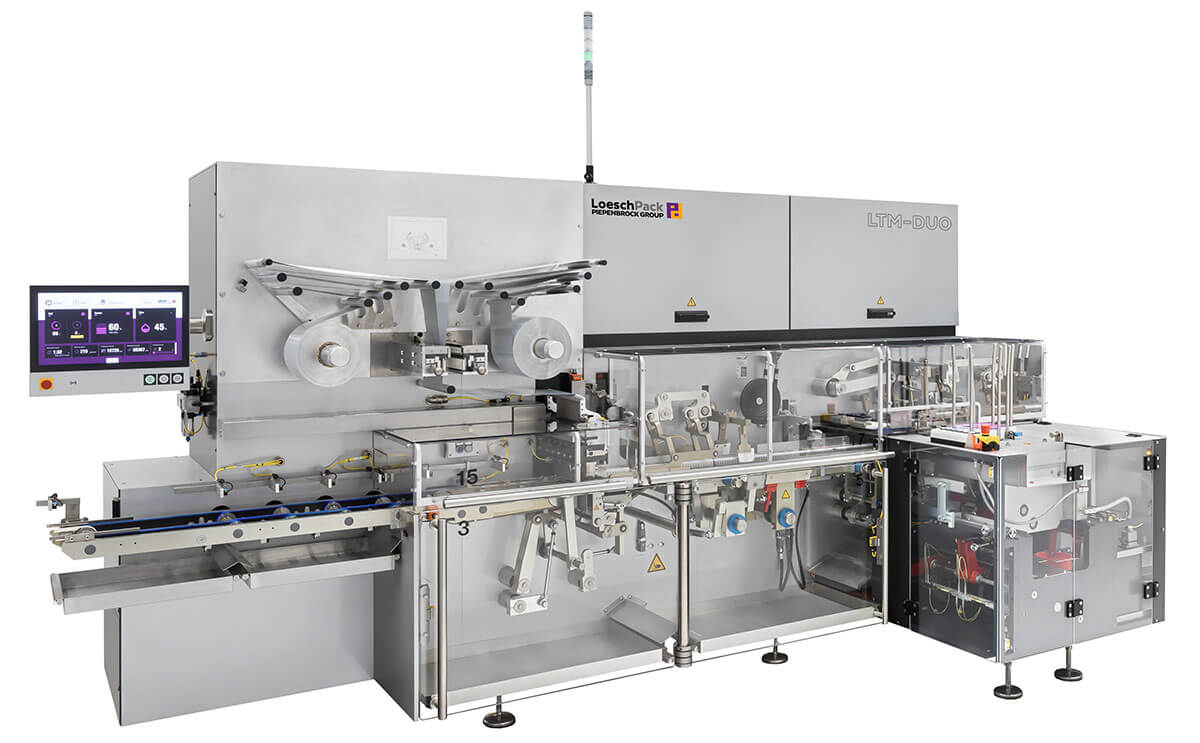
LoeschPack has built fold wrapping since 1919, and the range is specific to the format. The LTM-DUO is a twin-station machine for tablets, running at up to 215 tablets per minute and handling tablets of up to 300 g, with a sealed inner foil and an outer paper or board wrap. The LRM-S handles bars, squares and wafers at up to 600 packs per minute in a single stage. Where volume is the driver, the two-lane LRM-2-S runs at up to 1,100 products per minute.
Flow wrapping
Film is formed into a tube around each product, sealed along its length, then sealed and cut at both ends. Faster, more material-efficient and hermetic, which matters when the product needs a barrier against moisture or oxygen.
This is the standard for everyday bars, protein and granola bars and anything sold on volume. The LoeschPack FHW-S sits at the top of that range, engineered for up to 2,100 products per minute. Flow wrapper ROI covers how a wrapping line is configured to hold its output shift after shift.
How to choose between them
Four questions settle it quickly.
- Does the pack need a barrier? A hermetic seal protects against moisture and oxygen. A traditional fold does not, and sealing variants exist that combine a hermetic pack with the fold-wrap look.
- What is the product worth? Fold wrapping costs more per pack in material and in machine time. On a premium tablet or a gift line it earns that back at the shelf. On a value bar the flow wrapped pack is the stronger commercial answer.
- How warm is the product at the wrapper? Fold wrapping applies no heat to the product. If your conditioning is tight, that is a process advantage as much as an aesthetic one.
- How many formats do you run? Seasonal and gift ranges multiply formats quickly in confectionery, so weight changeover heavily if your calendar looks like that.
The part ahead of the wrapper
Most chocolate packaging problems start upstream. Product arriving warm, arriving out of pitch or arriving in surges will defeat any wrapper, and the marks and breakage that result get blamed on the machine that was simply handed bad input.
Conditioning, transfers, accumulation and lane changes are where chocolate is damaged. LoeschPack builds feeding, distribution and buffering equipment alongside the wrappers for that reason, and specifying the two together is the difference between a line that runs and a line that mostly runs.
If your product is fragile in a different way, cookie and wafer packaging covers the breakage case in more depth. And if you are earlier than this and still working out which machine class you need, what packaging machine do I need starts further back.
What happens after the wrap
Chocolate rarely ships as a single wrapped piece. Multipacks, display cartons and shelf-ready formats are usually part of the same project, and they need sizing alongside the primary wrapper instead of after it.
LoeschPack builds tray loading, cartoning and overwrapping to sit downstream of its own wrappers, which removes the interface risk that shows up when two suppliers meet mid-line. Cartoning machine selection covers that stage.
Tell us about the product and the shelf
Confectionery is where LoeschPack made its name, and it is the technology and quality leader in the field. It has built flow and fold wrapping since 1919, exports around 85 percent of what it makes, and builds to ISO 9001 and ISO 14001. There is chocolate wrapped on a LoeschPack machine on shelves across the world, including at Lake Champlain Chocolates in Vermont, whose wrapping and cartoning line you can watch running further up this page. Piepenbrock Packaging Technologies (PPT USA) is the North American arm of the same family-owned group, in business since 1913, so the team that specifies your line also commissions it and supports it.
Send us the product dimensions and weight, the temperature it arrives at, the pack you want on the shelf and whether it needs a barrier. Tell us the SKU mix and whether it swells at holidays. You will get the wrapping class that fits, what the upstream conditioning has to do, and a trial on your own product so the rate is proven before you buy it.