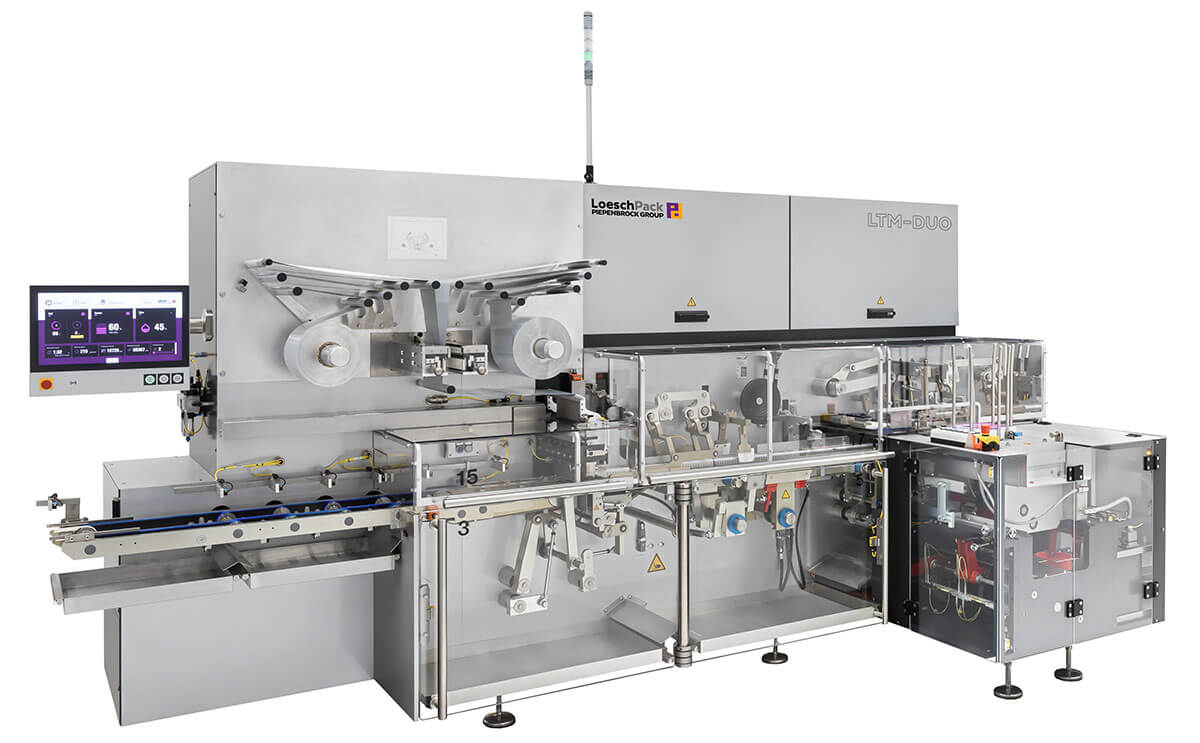
Flow Wrapper ROI: What Actually Drives Payback in High-Speed Packaging?
Six things decide what a flow wrapping line delivers on your floor, and every one of them is a decision you make before you sign. Here is how each one moves the payback.

A flow wrapping line pays for itself in finished saleable packs per shift. That number is engineered, and six decisions put it where you want it.
All six are settled before you sign. Piepenbrock Packaging works through them with LoeschPack during specification, so the line that arrives is configured around your product, your format and the output you need.
What the platform is built to do
The LoeschPack FHW-S is engineered for high-speed flow wrapping, running at up to 2,100 products per minute with film speeds of up to 205 m/min. That is the performance envelope of the platform, and it is the ceiling your configuration is designed toward.
Where a line sits inside that envelope is set by the product, the pack length, the film and the way product arrives at the sealing jaws. Those are engineering decisions, and they are where most of a specification gets spent: present your product to the wrapper cleanly and at pitch, and you capture more of what the platform can do.
The number your finance team cares about
Sustained finished packs per shift. It comes from three things multiplied together: how fast the machine runs while running, how much of the shift it runs at all, and how much of what comes off the end is saleable.
A wrapper delivers its rate when product arrives oriented, at the right pitch, with no gaps. Every flight that arrives full is a cycle converted into a finished pack.
So the infeed and the buffering ahead of a wrapper carry more of the line output than the wrapper itself does. That also makes them the most economical place to add throughput.
Six places payback is won or lost
Feeding and buffering
This is where the biggest gains usually sit. LoeschPack builds buffering, feeding, and distribution equipment alongside the wrappers, designed as one system, so product reaches the wrapping machine oriented and evenly spaced. A wrapper fed properly holds its average across a whole shift, and getting the feed right is almost always the cheaper way to lift annual output.
Changeover
Running one SKU? Skip this section. Running six? It may be your biggest number.
Changeover is production time. The gap between a twenty-minute change and a ninety-minute one, several times a week, comes to weeks of output across a year. Time it during factory acceptance with your own crew and your own tooling, so the number you plan around is the one you will see every week.
Film cost and flexibility
Film is a recurring cost that dwarfs the machine over its life. A wrapper that runs a thinner structure reliably, or moves between paper and plastic films without a rebuild, protects you from price movement and from a customer change nobody has mentioned to you yet.
The current FHW-S runs paper and plastics, changed at the touch of a button, and handles cold seal and heat seal work equally well.
Damage and rework
Every product you do not break is product you sell, so gentle handling pays twice: yield goes up and rework goes down. Breakage almost always originates upstream, at transfers, accumulation and lane changes, which is why LoeschPack engineers the product path as carefully as the sealing head. Fix the handling and the same wrapper delivers more saleable packs per shift.
Operating burden
Autosplice is standard on the current FHW-S, so a film reel change does not stop production. The platform is built for low cleaning and maintenance effort, with access designed around operation, maintenance and cleaning from the start.
Both of those convert straight into shift hours, and your line already produces the numbers: reel changes per shift, and the time your sanitation regime takes.
Availability
These machines are designed for three-shift operation, and that shows up in the details: access for cleaning, wear part replacement and fault clearance is built in rather than worked around. A machine built for continuous running is one you can keep running, and availability multiplies straight into annual output.
Build the payback from your own numbers
Build it from your own plant data. Six lines make a model that survives a finance review:
- Current sustained output per shift, and the target you need.
- Current downtime, split into changeover, faults and starvation. Most plants have never separated starvation out, and it is the one buffering fixes.
- Current film cost per pack, and what a different structure or a tighter gauge would change.
- Current damage and rework, and where in the line it originates.
- Labor actually deployed on the line, including whoever clears jams and reworks product.
- Changeover frequency and duration across your real SKU mix.
Numbers off your own floor make the strongest case, and our team will help you assemble them. Packaging automation ROI goes further into the seven places the money moves.
What this means for your shortlist
If upstream variation is your constraint, buy buffering before speed. If SKU complexity is, weight changeover heavily in the evaluation. If film cost or a coming packaging change is, weight material flexibility and plan a trial early. If breakage is, fix the product path first: cookie and wafer packaging covers the fragile case.
And if the pack ends up inside a retail carton, size the wrapper and the cartoner together. Cartoning machine selection covers what doing it sequentially costs you.
Send us the constraint, not the spec
LoeschPack has built flow and fold wrapping since 1919 and exports around 85 percent of what it makes, to plants that expect the machine to still be earning its keep two decades later. It builds to ISO 9001 and ISO 14001. North American producers run these lines today, Lake Champlain Chocolates in Vermont among them. Piepenbrock Packaging Technologies (PPT USA) is the North American arm of the same family-owned group, in business since 1913, so the team that specifies your line also installs it, commissions it and supports it across the United States, Canada and Mexico.
Tell us:
- The product, its dimensions and weight, and whether it is soft, sticky or coated.
- The pack format and film structure, or a note that the material is still open.
- The rate you need sustained, and the shift pattern.
- What limits the line today: infeed, wrapper, downstream, changeover or breakage.
- The SKU mix the line has to cover.
Send us as much or as little of that as you have. You get the LoeschPack architecture that fits, the sustained output it will hold on your own product and the short list of things worth proving on a sample before you commit capital.