Vertical Form Fill Seal Machines: The Complete VFFS Buyer's Guide
A VFFS machine is one link in a chain that runs from where product leaves production to a sealed, correctly weighed bag. Specify the whole chain and the line delivers what the bagmaker is built for.

A vertical bagging line is only as strong as the stages feeding it, and that is good news: much of the output available to you is won upstream, without buying a faster machine.
The machine forms film into a tube, seals the bottom, drops in a measured quantity and seals the top. That description fits every vertical form fill seal machine ever built, and it explains almost nothing about what separates a line that hits its numbers from one that does not.
Think of VFFS as a chain instead of a machine. It starts where product leaves production and ends with a sealed, correctly weighed bag. The bagmaker is one link, and every link is a place to design output in.
The chain, in order
Five stages, and each one is worth specifying deliberately.
- Feeding. Product moves from production to the packaging area by vibratory conveyor, belt or bucket elevator. Gentleness matters for anything fragile, and so does consistency: a feed that surges makes every stage downstream work harder.
- Distribution and buffering. Product spreads across the weigher's infeed and, ideally, buffers so a short interruption upstream does not starve the line. This stage is routinely under-specified and is often the cheapest way to lift output.
- Weighing or dosing. A multihead weigher combines partial weights to hit a target, or a volumetric doser measures by volume for free-flowing product where weight accuracy matters less.
- Forming and filling. Film is drawn over a forming shoulder into a tube, the vertical seal is made, the bottom seal closes the bag and the weighed quantity drops in.
- Sealing and discharge. The top seal closes the bag and the cut releases it, usually onto a takeaway conveyor heading for checkweighing, metal detection and case packing.
What sets your bags per minute
Hastamat's R and RM series are engineered for high-output bagging at up to 250 bags per minute, with film widths of up to 800 mm and bag volumes of up to 10,000 cubic centimeters. That is a wide envelope on one platform, and four configuration inputs decide where your line sits inside it.
Each of the four is settled during specification:
- Bag size. A large bag draws more film, holds a longer seal dwell and takes more product per cycle, so a single platform covers single-serve and family format at different cycle rates. Define the format range you need and the machine is configured for it.
- How your product falls. Product has to clear the seal area before the jaws close. Light, fluffy or slow-settling product needs longer, or the line needs a system that closes the jaws around the falling product instead of waiting for it.
- Film structure and seal requirement. Film that needs longer dwell, higher temperature or more pressure to seal reliably costs you cycles directly. This matters most when a plant moves to a recyclable or paper-based structure, covered in running paper and recyclable materials.
- Weigher cycle. The bagmaker runs at the pace the weigher feeds it. Hastamat CP weighers are built for up to 240 weighing procedures per minute with up to 24 hoppers, and matching that cycle to the bagmaker is why the two are specified together.
Weighing is where the money is
On most VFFS lines the weigher, not the bagmaker, sets both the rate and the profitability. A multihead weigher divides product across many hoppers and picks the combination closest to target, which is how a line stays tight to its declared weight instead of quietly overfilling.
Giveaway compounds silently. A few grams over target on every bag, at hundreds of bags per minute across three shifts, becomes a material cost line that never once appears as a fault. How a multihead weigher reduces giveaway works through the mechanism and how to put your own number on it.
Changeover and sanitation
Two things decide how a VFFS line runs day to day, and both are settled at specification.
Changeover means swapping the forming set, adjusting film tracking and re-establishing seal parameters. On a plant running several SKUs a day, the difference between a twenty-minute change and a ninety-minute one is enormous. Time it during factory acceptance with your own crew, so the number you plan around is the one you will live with.
Sanitation means what has to come off, how fast it comes off, and whether it can be cleaned wet. In any wet or frozen application that is a specification decision, not a preference. Frozen and IQF packaging covers what changes when the product is cold, wet or fragile.
When a horizontal wrapper is the better fit
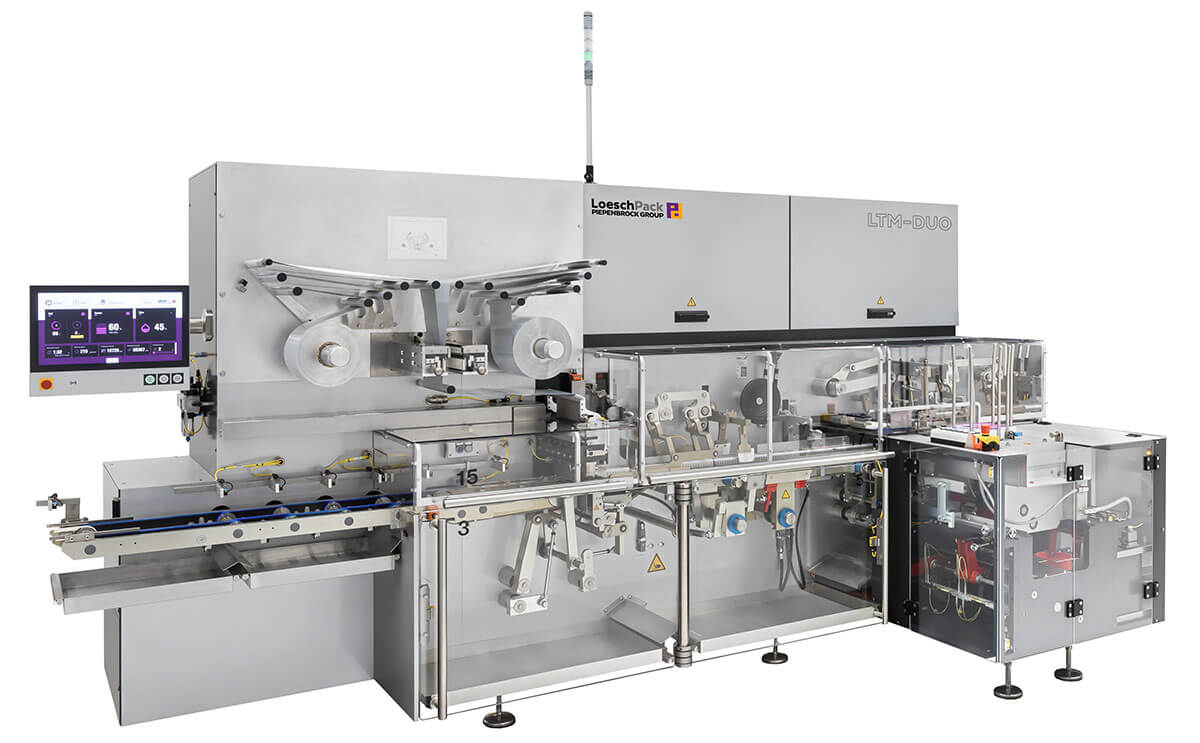
VFFS suits product handled by quantity. Product that has to be individually oriented, presented in a rigid flat pack or protected from any drop belongs on a horizontal wrapper, and LoeschPack builds those.
If you are weighing that decision, VFFS versus flow wrapper is the direct comparison, and it uses cookies as the example because they are the case that goes either way.
What we need to specify a line
Hastamat has built weighing, dosing and bagging equipment since 1953 and is one of the strongest names in vertical bagging. PPT USA specifies, installs, commissions and services those lines across the United States, Canada and Mexico.
Send us:
- The product, its bulk density and how it behaves when dropped, including whether it makes fines.
- Target fill weight, and the giveaway you are living with today.
- Bag format and dimensions, plus any format range the line has to cover.
- The film structure, or a note that it is still open.
- Bags per minute needed sustained, and the sanitation regime the area runs under.
With that you get the weighing and bagging configuration that fits, the output it will hold sustained and a trial on your own product so the rate is proven before you commit to anything.