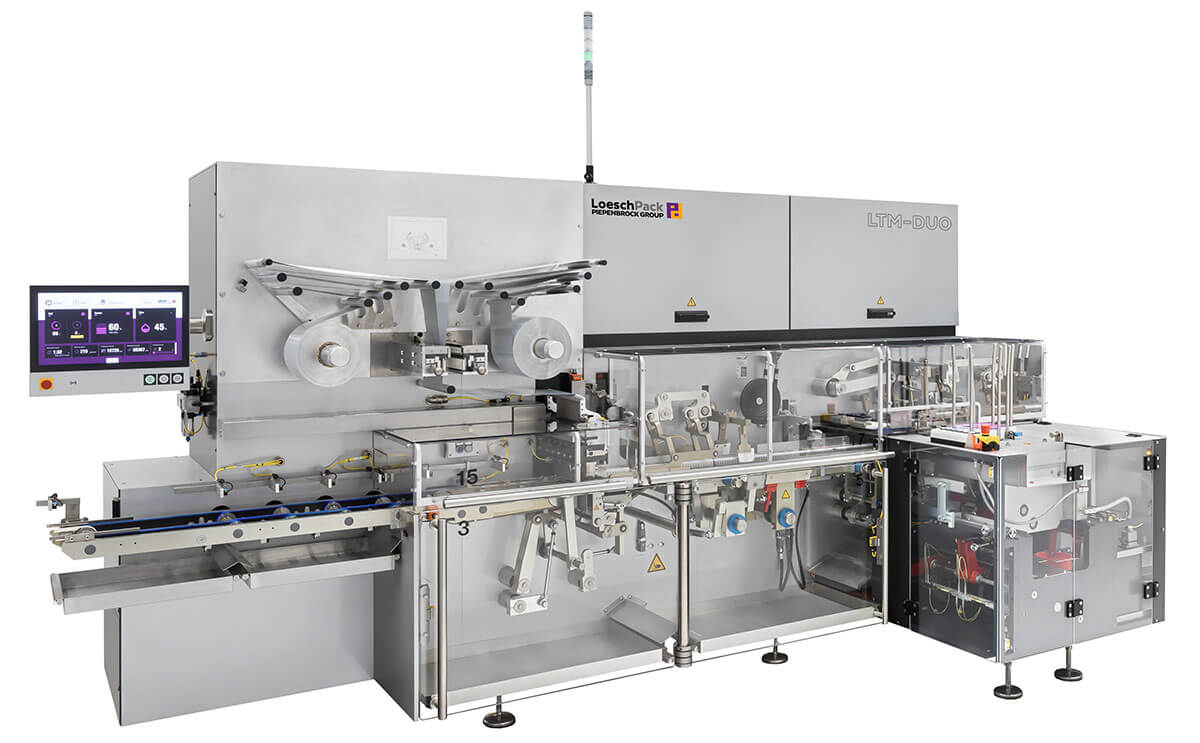
Running Paper and Recyclable Materials on Packaging Machinery
Paper and mono-material structures touch the machine at every stage, and each stage is a configuration decision. Here is what changes, and how a platform built for material flexibility takes it in stride.

Your packaging is changing, and the platform you run it on can be ready for it.
Retailer commitments, extended producer responsibility schemes and your own customers are pushing the same direction, and the timelines usually arrive already fixed. The question that lands on an operations desk is narrower: what does this mean for my line?
It means a set of decisions, because a packaging material touches the machine at every stage and each stage responds to a different property. All of them are configuration decisions, and all of them are decisions LoeschPack has been engineering for a century.
Where a new material changes behavior
Unwinding and web handling
Stiffness and coefficient of friction change how a web tracks, tensions and turns. Paper-based structures prefer generous radii and steady tension, so web path and tension control are worth specifying deliberately around the material you are moving to.
Forming
Film is asked to take a shape and hold it, around a former on a vertical machine or into a tube on a horizontal one. A stiffer structure holds its shape differently, so the forming section is tuned or tooled to suit it. That is ordinary engineering on a platform built for more than one material family.
Sealing
Sealing is where a material change shows most. A sealing layer that prefers longer dwell, higher temperature or more pressure sets the cycle, so the sealing system is configured around the structure you intend to run. Mono-material constructions concentrate the decision further, since the layer that seals and the layer that provides strength are the same polymer. Machines built for cold seal and heat seal applications alike carry the widest room to work in, and the current FHW-S platform is built for both.
Cutting
Paper-based structures cut differently from film and wear tooling on their own schedule. Specify the cutting components for the structure and set the maintenance interval with the material in front of you, and cut quality holds from the first pack of the run to the last.
What the machine can offer
The capability that matters most here is flexibility, because the material story is still developing and whatever you specify around today will evolve again.
The current FHW-S platform runs paper and plastics, with the change between them made at the touch of a button, and it is built for cold seal and heat seal applications alike. Autosplice comes as standard, so a reel change does not stop production. You can move between material families without a rebuild and trial a new structure without committing the line to it. That is advanced packaging technology aimed squarely at the decade of material change ahead.
Your achievable speed on a given structure is then an engineering outcome, set by the material, the format and the machine configuration together. We establish it on the machine with your own material, so the number in your plan is a measured one.
Prove it on the machine
A material change is a process change with a purchasing component, and the fastest route through it is a structured trial.
- Fix the format first, so the trial measures the material and nothing else.
- Run your actual product. Weight, temperature and surface all affect sealing and handling.
- Run long enough for the process to settle. Seal quality across an hour tells you more than seal quality across ten minutes.
- Measure seal integrity across the whole run, and cut quality at the end of it as well as the start.
- Record the speed you achieve, and carry that number into your business case.
Both LoeschPack and Hastamat run technical centers where you can test with original material and your own formats. That is the right place to answer a material question, comfortably ahead of production.
The costs that come with the change
Build the whole picture before committing, since the material price per kilogram is rarely the biggest term.
- Achievable line speed, which carries the largest effect on annual output and is the first thing worth measuring.
- Tooling and wear parts, including any change to sealing jaws or cutting components and the replacement interval that comes with them.
- Scrap during changeover and setup, which settles as the crew learns the material.
- Seal integrity through distribution, and what pack quality is worth to you in the field.
- Format tooling if the pack geometry changes alongside the material.
Packaging automation ROI covers how to fold those into a model, and what an industrial packaging machine costs covers where material sits in total cost of ownership.
If your line is cold or wet, the interaction between a new structure and condensation deserves separate attention. Frozen and IQF packaging covers that environment.
Bring us the material and the product
This is a good moment to have machinery built by people who have been solving material problems for a century. LoeschPack has run wrapping materials since 1919 and states packaging material flexibility for paper and plastics on the current FHW-S, changed at the touch of a button. Piepenbrock Packaging is the North American arm of the same family-owned group, in business since 1913, and we specify, install, commission and support these lines across the United States, Canada and Mexico.
Tell us the structure you are moving to, the format, the speed you need to hold and the deadline you are working against. You will get a trial plan, a measured answer on speed and a clear verdict on whether your existing machine comes along or is better replaced. Starting early is what turns a mandate into a well-run project.